Policy leaders in the fintech space gathered in Washington DC yesterday for the seventh annual American Fintech Council Policy Summit. It was a full day of learning and networking that provided a real sense of where the fintech industry is at right now. The tone was not overly optimistic or pessimistic. Instead, there was a series of no-nonsense, no-hype conversations about what is most important when it comes to fintech policy issues.
I am going to hit on some of the agenda highlights in this article, focusing on the keynote sessions which were all excellent.
The first keynote of the day was Jelena McWilliams, former Chairman of the FDIC and now a managing partner at Cravath, Swaine & Moore LLP. She started off by saying that Banking-as-a-Service is here to stay, despite some of its current challenges but fintechs need to navigate compliance issues better. Banks have the ultimate responsibility for this but if the bank cannot easily explain what the fintech is doing to regulators that can have serious consequences.
She talked about the banking crisis from earlier this year and while she didn’t disagree with the action taken, having unlimited deposit insurance would be a very expensive proposition for banks. She floated the idea of different insurance coverage on specific accounts, such as payroll accounts, but regardless banks with a high percentage of uninsured deposits need to manage their risk differently. While she didn’t comment on the current scandal at the FDIC she did say that the agency has become politicized for the first time in its 89-year history and no longer has complete independence from the executive branch.
Earned Wage Access (EWA) is one of the hottest niches in fintech right now, so we heard from the CEO and founder of Earnin, Ram Palaniappan, one of the leading players in the space. He talked about the two million people that Earnin has helped gain early access to their wages with the major use cases being rent, gas and groceries. The interesting point he made is that once an employee starts using the Earnin system their wages go up. This is probably because the app tracks their earnings in real time, so they have much more awareness of their wages and are more likely to take on extra work. While Ram applauds some of the states that have taken the lead in creating a regulatory framework for EWA he said we need national legislation in order to create a unified system for consumers.
Congressman Mike Flood (R-NE) took time away from a busy week on Capitol Hill to provide his perspective on a variety of policy issues impacting fintech. Before coming to Congress he spent time in the Nebraska legislature and helped champion their Financial Innovation Act which authorized state chartered banks to custody crypto. He clearly understands crypto and is passionate about financial innovation which is why he wanted to be on the House Financial Services Committee (he is also on the Digital Assets, Financial Technology and Inclusion subcommittee).
He talked about the Financial Innovation and Technology for the 21st Century Act (or FIT Act) which has been called “the most comprehensive crypto regulation ever voted on by Congress”. It is a bipartisan bill that Congressman Flood thinks will be passed by the House but they will have to work hard to get it through the Senate. He lambasted the SEC for wanting any bank that custodies digital assets to include it on their balance sheet. He pointed out that BNY Mellon custodies over $17 trillion in traditional assets, and it is not required to report this on their balance sheet and the same should be true for digital assets.
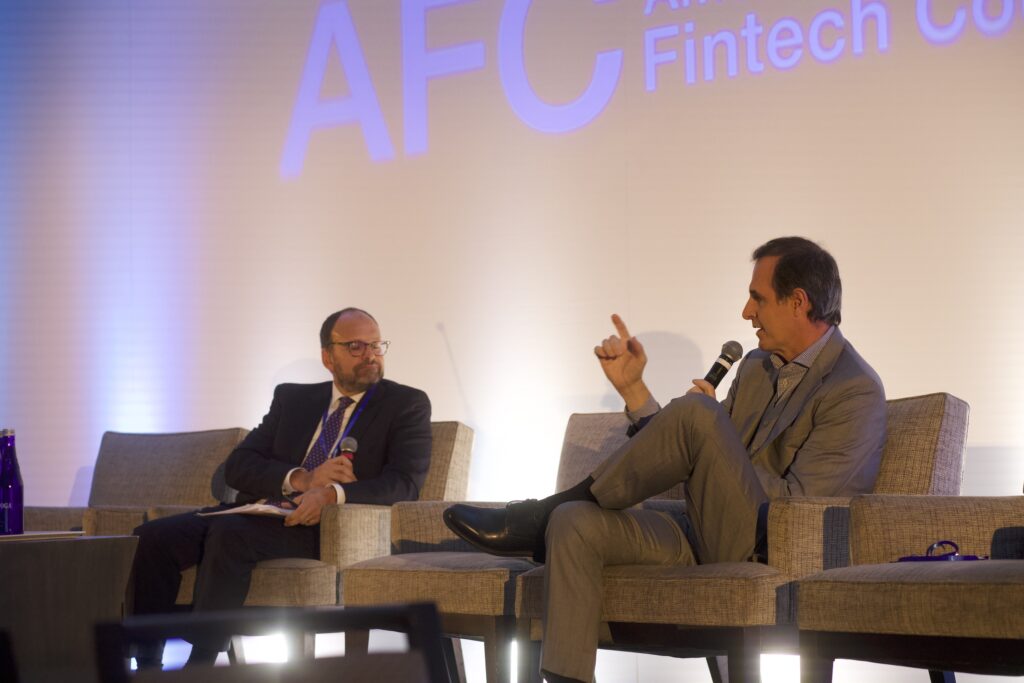
Renaud Laplanche, the CEO and Co-Founder of Upgrade, one of the original fintech entrepreneurs, talked about some of the lessons learned from his many years fintech. He pushed back on the notion that fintechs should become banks, arguing that the operational and capital requirements are challenging and that fintechs have the potential to be far more nimble and innovative. He is happy to partner with banks instead of seeking a banking license.
Renaud teased a new product that is launching soon, a secured credit card with some unique features. When asked what he would like to see on the regulatory front he simply said: stability. That is the best you can hope for right now. He did mention the CFPB has been a good partner for fintech providing clarity and transparency on their regulatory objectives.
Mark Gould’s title is officially the chief payments executive for Federal Reserve Financial Services but he is more widely known as the head of FedNow, the Fed’s new instant payment service that launched in July. He gave an update on the rollout of FedNow. After having launched with 30 banks there are now more than 200 on the platform today. He talked about how they deliberately segregated the team working on FedNow so they could think and act more like a startup.
He recognized that in order to scale FedNow rapidly they needed to enable the industry. He pointed out it is not a zero-sum game in instant payments and that they need RTP to be successful as well. The Fed did not release a fully featured system right out of the box and that was deliberate. They wanted to get FedNow into the market and then receive feedback from their customers. As far as what is coming, he said they are focused on the rollout right now and that new features will be forthcoming in time but the priority right now is to reach more scale.
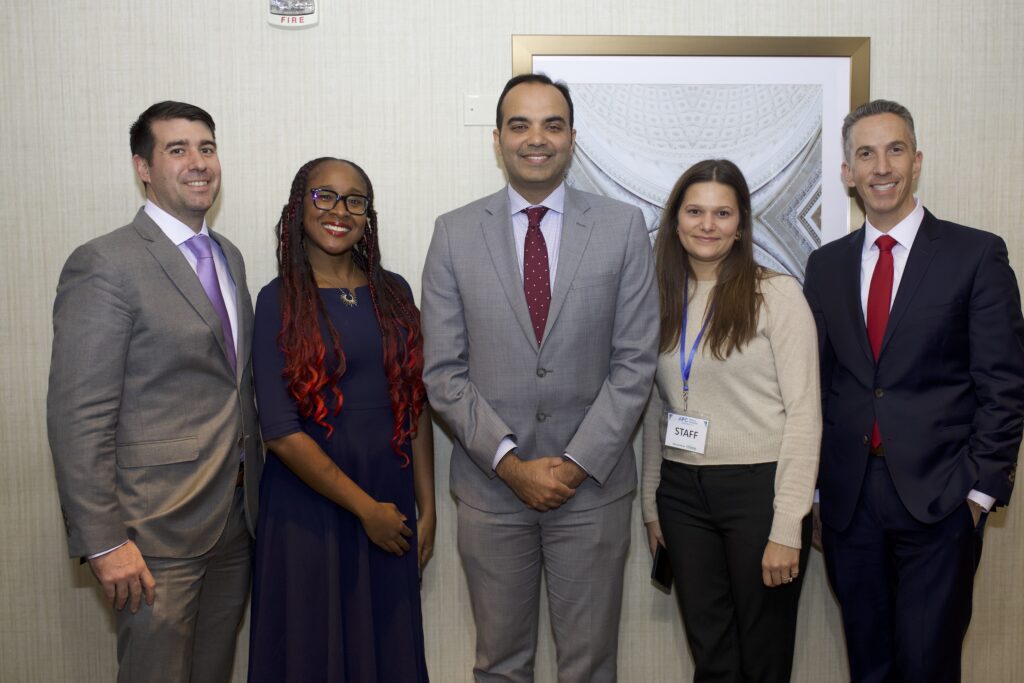
The last keynote speaker of the day featured a standing-room-only crowd for CFPB Director Rohit Chopra. The director wants to make sure our financial system is fair, transparent and competitive. He is looking for innovation that can create real change not just taking advantage of regulatory loopholes. He reiterated their thinking behind the new open banking rules and encouraged everyone to place their comments.
For open banking to accelerate and succeed in the US companies need to be transparent with data and provide real value. You can’t just offer a loan as a pretext for gathering data. We need sensible standards for open banking data, regulations cannot be so complex that they do not stand the test of time. He also said that open banking could be crippled if there is one main player that has all the power, we need a competitive market here. In a wide-ranging Q&A he commented on chatbots (don’t deploy them too fast), AI in underwriting (need to explain adverse action notices) and he wants to remove the bias when it comes to home appraisals. He ended with some commentary on small business, saying that open banking concepts are just as applicable there.
Of course, there were also a number of fascinating panels throughout the day covering topics such as banking-as-a-service, the state regulatory push, emerging fintech markets, third-party risk management, AI and alternative data, understanding novel activities and AI and regulatory innovation. There were a number of intimate roundtables on a variety of topics running throughout the day as well as a sold-out women-in-fintech luncheon.
It was an action-packed day with an enthusiastic crowd who, judging by the comments I received at drinks afterward, were very happy with what they learned and the people they met.
The AFC hired Fintech Nexus to help produce this event so we our team worked closely with the AFC on all aspects of the event. Kudos must go to AFC CEO Phil Goldfeder and his team who worked tirelessly in the days and weeks leading up to yesterday to ensure a successful event was enjoyed by all AFC members and other attendees.

Credit: Source link