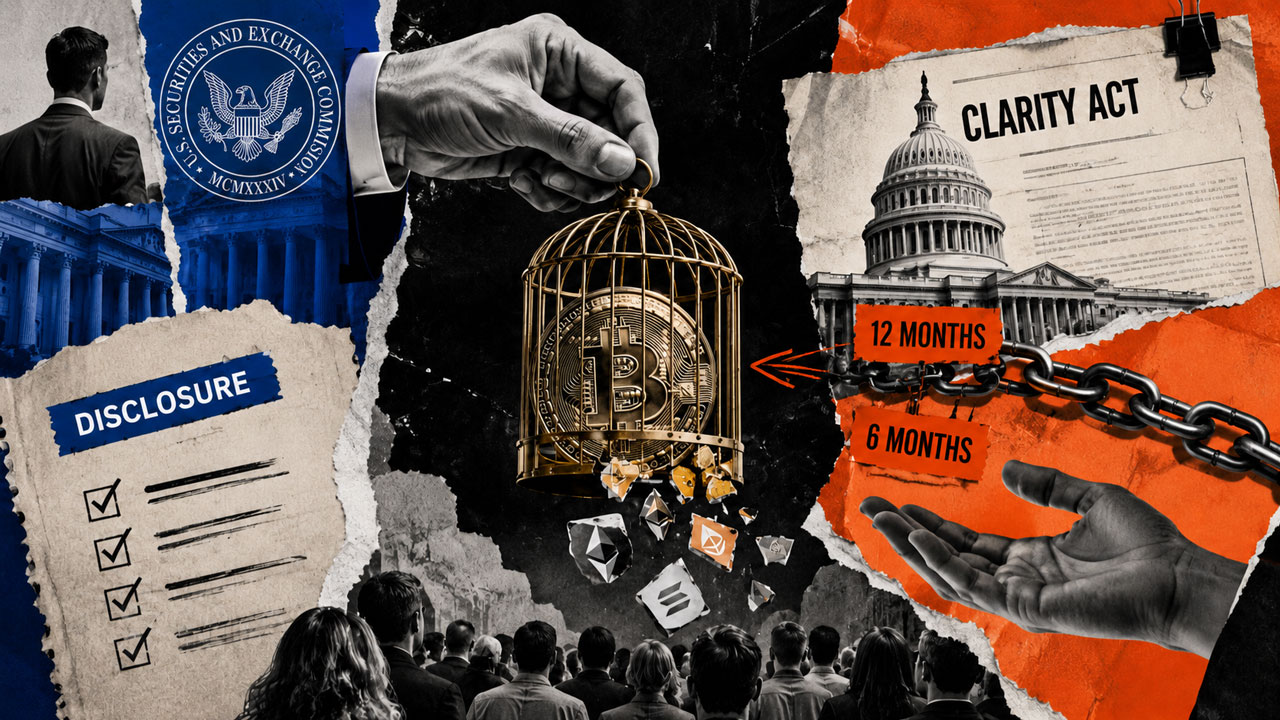
The SEC’s new crypto fundraising proposal deliberately treats tokens as free to trade as soon as a buyer acquires them, unless the issuer or another law says otherwise.
Insiders typically know more than the public while a token project is still being built, and their incentives do not always line up with everyone else’s.
The Senate’s July 22 CLARITY draft would force insiders to hold a token for a full year before its network clears a specific control test, then six more months once it does. The bill also limits how much they can sell, but the SEC’s proposal skips those requirements.
| Question | SEC Regulation Crypto Assets proposal | Senate July 22 CLARITY draft |
|---|---|---|
| Are tokens freely tradable after purchase? | Generally yes, unless another restriction applies | Not for related persons covered by the lockup rules |
| Is there a mandatory insider holding period? | No | Yes |
| Before network control certification | No federal time-based lockup | 12-month minimum holding period |
| After certification | No federal time-based lockup | 6-month minimum holding period |
| Main investor protection tool | Disclosure | Mandatory holding period plus volume limits |
| Core philosophy | Let buyers price disclosed insider risk | Force insiders to stay economically exposed |
How the SEC reached its decision for crypto insiders
The SEC’s Regulation Crypto Assets spends space building the case for insider lockups before setting one aside. It discusses the information gap between insiders and buyers, reviews research showing token offerings tend to do better under vesting or lockup terms, and then settles on disclosure as its answer.
Issuers get to decide whether to restrict their insiders, and the SEC goes one step further by asking commenters whether it should require a one-year holding period before finalizing the rule.
That question wouldn’t make sense if the draft already included a one-year period.
The proposal still caps how much insiders can sell, even without a mandatory holding period. A Tier 2 offering under the SEC’s fundraising exemption can raise up to $75 million in a year, and affiliates of the issuer can supply up to $22.5 million of that. Tier 1 tops out at $20 million total, with $6 million available to those same insiders.
| SEC fundraising tier | Total offering cap | Affiliate selling-securityholder cap | First-year insider sale cap | What remains uncapped by time |
|---|---|---|---|---|
| Tier 1 | $20M | $6M | 30% of aggregate offering price | No mandatory holding period |
| Tier 2 | $75M | $22.5M | 30% of aggregate offering price | No mandatory holding period |
A separate cap kicks in during an issuer’s first year of offerings, capping securities sold by insiders at 30% of the total raise. Run the math on a full $75 million Tier 2 offering, and that ceiling lands at $22.5 million, the same number as the affiliate cap itself.
The caps govern how much insiders can sell through a qualified offering, leaving timing as the real open question. An insider can sell the moment a token stops counting as a restricted security, with no minimum holding period required.
The Senate draft, in a section titled Special Restrictions on Disposition, requires insiders to hold a covered token for at least 12 months before its network is certified as free of coordinated control.
Once that certification lands, the minimum drops to six months, and the bill still caps how much an insider can sell in any 12-month stretch, with the SEC left to set the number.
Two different definitions of insider
The comparison gets messier when looking at who counts as an insider under each framework.
The SEC casts a wide net built for disclosure, covering founders, employees, directors, consultants, and even immediate family members. Congress draws tighter lines based on crypto ownership thresholds, such as founders holding at least 4% of a project’s ancillary asset or holders controlling at least 10%.
Decentralized governance systems are excluded from the definition altogether.
Both describe the same idea of someone close enough to a project to know things the public does not. They just built that idea with different legal architecture, two different tools aimed at a similar problem.
| Category | SEC proposal | Senate CLARITY draft |
|---|---|---|
| Founders | Covered broadly | Covered if they meet specified ownership thresholds |
| Employees and officers | Covered broadly for disclosure purposes | Covered through executive/director and control-based categories |
| Consultants and advisors | Covered broadly | Not captured as broadly unless they meet other criteria |
| Large holders | Covered through affiliate/related-person concepts | Covered through ownership thresholds such as 10% holders |
| Family members | Included in the SEC’s wider related-person framework | Not the central focus of the threshold-based test |
| Decentralized governance systems | Not the main definitional carveout | Excluded from the related-person definition |
Every detail in this comparison points back to the same underlying question. Should token buyers price insider risk themselves once it’s disclosed, or should insiders be legally forced to stay exposed to that same risk while the project is still finding its feet?
The SEC’s economic analysis argues both sides, saying easier exits for founders and early employees can encourage investment and free up capital for its next use. In the same breath, the Commission admits that large insider sales can make the very conflicts a lockup would prevent even worse.
The SEC’s proposal is built for crypto tied to an issuer that still has work to finish. That description fits early-stage projects far more than an asset with no roadmap, and no team left to deliver on one.
That gap between Bitcoin and most of the tokens this rule governs is why the lockup debate barely touches Bitcoin.
Which version of crypto insider liquidity wins
The bull case for tighter insider rules has the SEC’s comment period building enough momentum to add a one-year holding requirement before the final rule ships.
Congress could also pass something close to its current CLARITY language first. Either path pushes US token fundraising toward a world where insiders carry the same downside as everyone else for a defined stretch.
The cost falls on the faster-liquidity founders and early employees were hoping for.
The bear case is that the SEC’s disclosure-first approach becomes the operating reality while CLARITY sits unfinished in Congress. Crypto lockups turn into something projects opt into for credibility, and a project with no restrictions at all can still raise money.
It just does so at a steeper discount, since the risk of insiders cashing out early stays on the buyer’s side of the ledger.
Neither version is law yet, and the two frameworks define insider in genuinely different ways. They agree the risk is real, but split on who has to live with it: the buyer who gets a disclosure or the insider who gets a deadline.
Credit: Source link