
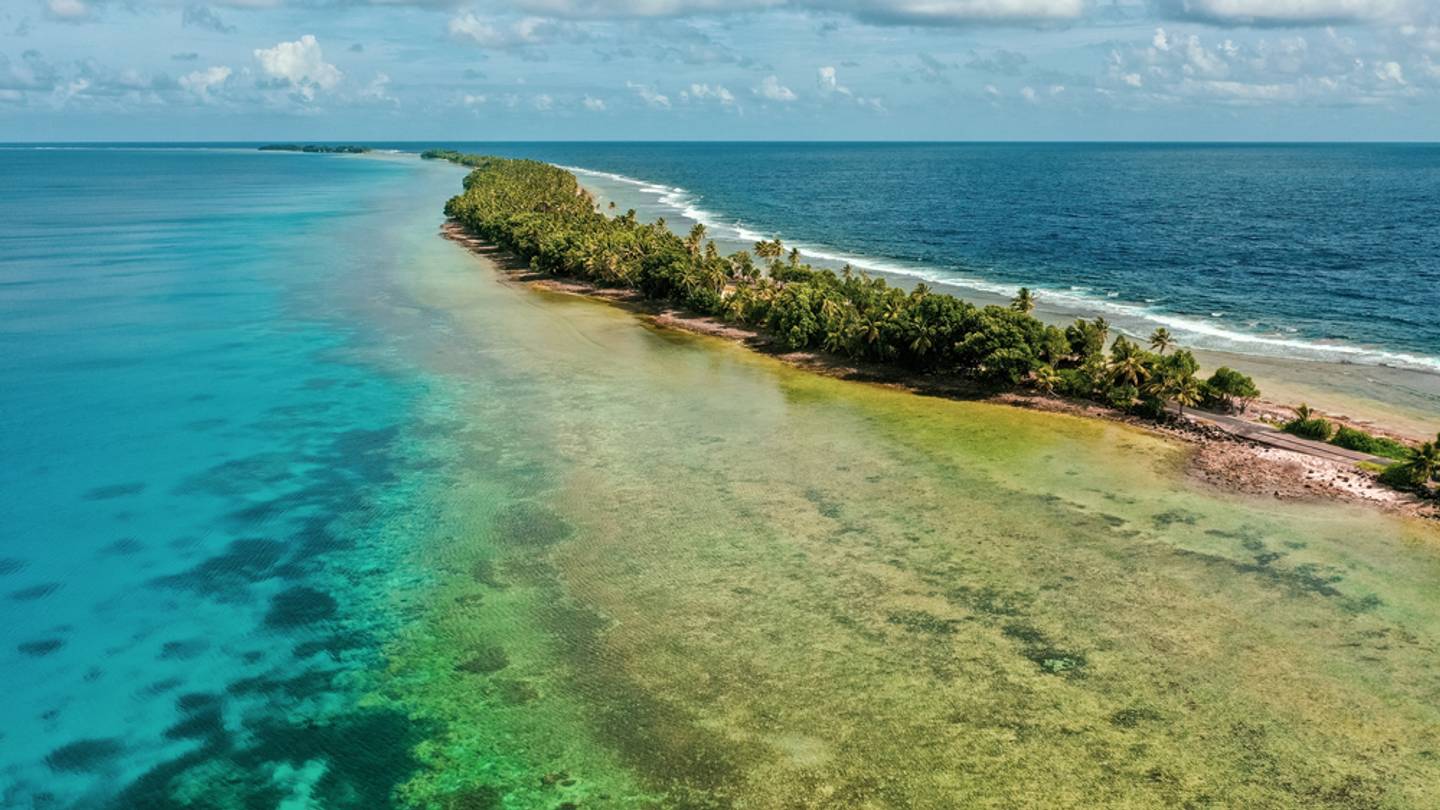
Out in the vast blue of the Pacific Ocean, about halfway between Australia and Hawaii, an idyllic tropical island nation is slowly being swallowed by the sea.
That nation is Tuvalu, and according to some projections, it may be entirely underwater by 2100 due to rising sea levels resulting from climate change. Already, water levels have risen 21 centimeters in 30 years, and residents have been forced to navigate intense high tides and increasingly frequent storms and severe weather events.
“While spring or king tides always come around in February, this year’s king tide is like nothing we have witnessed before,” wrote Niuone Eliuta in 2024, per ReliefWeb. “This week, the island’s one main road has succumbed to the fury of nature, submerged beneath torrents of seawater, exacerbating the already dire situation faced by Tuvaluans. With this year’s storm surges and the rising sea inundating vital transportation routes, many Tuvaluans are questioning their future in the face of the unyielding climate crisis.”
Residents prepare for their island to disappear
Tuvalu is home to around 11,000 people, who live in a tropical paradise spread across nine coral atolls and islands. Already, though, most of them are making preparations to leave home.
In 2023, the Tuvaluan and Australian governments launched a treaty called the Falepili Union, which will allow 280 Tuvaluans to move to Australia per year. In 2025, over 90 percent of the island’s residents applied for the visa scheme, which allows them to receive either residency or citizenship.
Efforts are still underway to protect Tuvalu against the rising tides. The United Nations Development Program, the Tuvaluan government, and the Green Climate Fund are collaborating on a project that involves dredging sand to create new swaths of land out of reach of the rising waves. Tuvaluans have also been taking matters into their own hands, planting mangroves along coastlines that can better help protect the shore against the tides while providing habitats for fish and crabs.
Tuvalu has also spent $2 million mapping its nine islands to better project coastal dangers, an endeavor that led them to conclude that coastal inundation events that used to happen every century are expected to occur every 10 years by 2050. Additionally, water scarcity, coral bleaching, health risks from vector-borne diseases created by a hotter climate, and increasingly severe weather events are all ongoing threats to every aspect of life on Tuvalu.
A digital recreation
In an effort to preserve some semblance of their disappearing nation, the nation’s government has been working on a unique kind of conservation project: a digital copy of Tuvalu. In 2023, they completed 3D scans of all the islands and uploaded them to a website. Additional efforts to document every inch of Tuvalu are underway.
The intention behind the digitization project is that in the future, people will be able to visit and explore a representation of the nation through the metaverse while also learning about its culture, language, and legacy.
“Tuvalu could be the first country in the world to exist solely in cyberspace,” Tuvalu’s Foreign Minister Simon Kofe said in a video shown to world leaders at the climate conference COP27, “but if global warming continues unchecked, it won’t be the last.”
The digitization project is one of three major prongs in Tuvalu’s Future Now Project, which is designed to help the nation navigate worst-case climate scenarios. The first prong is focused on persuading nations around the world to focus on climate change solutions, an endeavor inspired by the Tuvaluan values of olaga fakafenua, or communal living systems, kaitasi, or shared responsibility, and fale-pili, or being a good neighbor.
The second is to ensure Tuvalu’s statehood and boundaries even if the land disappears. The third is to create a comprehensive digital archive of the nation that can last long after it is gone.
A call for change
Tuvalu is not the only island nation that faces threats from rising sea levels and spiking temperatures. The Marshall Islands, the Florida Keys, the Seychelles, and the Maldives are just some of the dozens of island nations that are projected to be mostly underwater within the next 50 to 100 years.
The largest driver of rising sea levels is climate change from fossil fuels. For many Pacific nations, permanent damage has already been done. Already, coastal storms, floods, droughts, and other climate-related issues pose major threats to countless communities. According to one estimate, there could be up to 1.5 billion climate refugees—or people displaced by various climate change-caused issues—by 2050.
Following a 2026 UN report that said the world is on track to exceed the 1.5°C warming limit set by the 2015 Paris climate accord, analysts have proposed that some projections may have actually significantly underestimated island nations’ vulnerability to sea level rise.
Meanwhile, vulnerable nations like Tuvalu produce very little of the planet’s greenhouse gas emissions in total, and Tuvalu itself has committed to reaching net zero by 2030. Unfortunately, the nations that contribute the least to climate change are very often the most vulnerable to it.
Tuvalu’s fate is unclear, but what is certain is that things are changing for the small nation—and the hotter the planet grows, the more vulnerable it becomes.
“Reducing emissions is essential, but it will not stop sea-level rise. Some rise is already locked in and will continue for centuries. For Pacific Island countries, adaptation is no longer optional,” said Herve Damlamian, ocean prediction and monitoring team leader at the Secretariat of the Pacific Community (SPC). “Every fraction of a degree of warming avoided matters because it slows sea-level rise and reduces how much future generations will face.”
In 2021, Kofe appeared in a video shown at COP26 and called for more decisive global action on climate change.
“We stand here today, not as a plea for sympathy, but as a call to action. The rising waters that surround us are not just threatening our homes; they are a stark warning for the entire world,” he said. “Tuvalu is on the front line of climate change, but we are not alone. The fate of Tuvalu is intertwined with the fate of every nation on this planet.”