
As the crypto markets lurch up and down, firms are still finding uses for blockchain outside of digital currency. This week, clinical trials were the latest economic sector to adopt distributed ledgers to improve their work.
On August 9, Care.Trials announced the launch of its Care.Trials network. A blockchain-based solution for clinical trials that uses zero-knowledge proofs (ZKPs) to ensure patient privacy. In the case of Care.Trials Network, its app matches patients to trials based on their preferences and health information. Patients can also be encouraged to participate in trials by earning their SOLVE token. The project also claims to be the first healthcare network of its kind to use ZKPs. But why are ZKPs so important?
Why Use Zero-Knowledge Proofs in Healthcare?
In recent years, zero-knowledge proofs have become an increasingly common privacy solution in Web3. Put simply, ZKPs are cryptographic protocols that enable one party (the prover) to prove to another party (the verifier) that a statement is true without revealing any specific information about the statement itself.
The most common thought experiment to show this is known as the “Ali Baba” cave. The cave, first imagined in 1990 by Jean-Jacques Quisquater and others in their paper “How to Explain Zero-Knowledge Protocols to Your Children,” imagines a traveler trying to prove he knows the password to a cave entrance without sharing the password itself.
A simplified version goes like this: Ali needs to show a friend that he knows the password without sharing it. By entering, leaving, and reentering the cave multiple times, Ali is able to convince his friend he knows the code. He does this without ever sharing the password itself.
ZKPs are an especially useful solution in a healthcare context because of the sensitive nature of individuals’ health records. With ZKPs, medical records can be shared and verified without revealing sensitive patient information. Clinicians and healthcare providers can also collaborate while also protecting patient confidentiality.
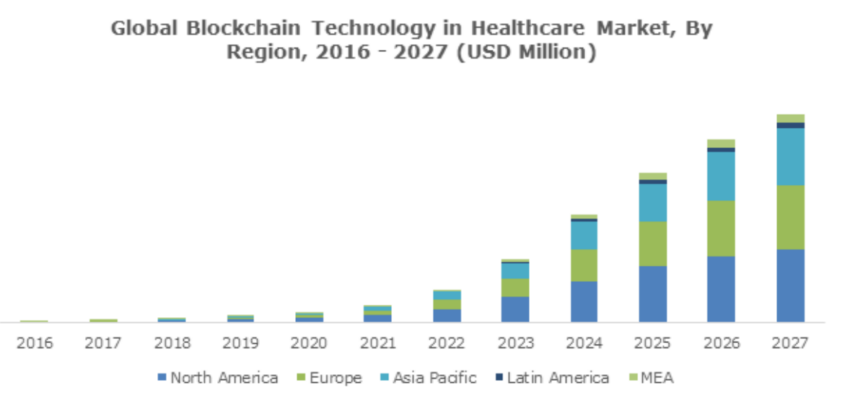
Blockchain in Healthcare is Estimated to Grow by $1.9 Billion by 2027
Although it isn’t just clinical trials where blockchain has its place. A 2022 systematic review of blockchain uses in the healthcare sector found several valuable use cases.
After the full screening, 22 papers were included ranging from January 2008 to September 2019. The authors found the technology could be useful in a range of applications, including electronic medical records, biomedical research and education, remote patient monitoring, pharmaceutical supply chains, health insurance claims, health data analytics, and more.
Furthermore, a study out on August 9 by Technavio is bullish about the growth of blockchain in healthcare more broadly. According to its findings, the global blockchain technology share of the healthcare market should grow by $1.9 billion from 2022 to 2027.
The market’s compound annual growth rate (CAGR) is expected to be 32.79% over the same period. Fully 46% of the total growth will be in North America, the study found.
Disclaimer
In adherence to the Trust Project guidelines, BeInCrypto is committed to unbiased, transparent reporting. This news article aims to provide accurate, timely information. However, readers are advised to verify facts independently and consult with a professional before making any decisions based on this content.
Credit: Source link