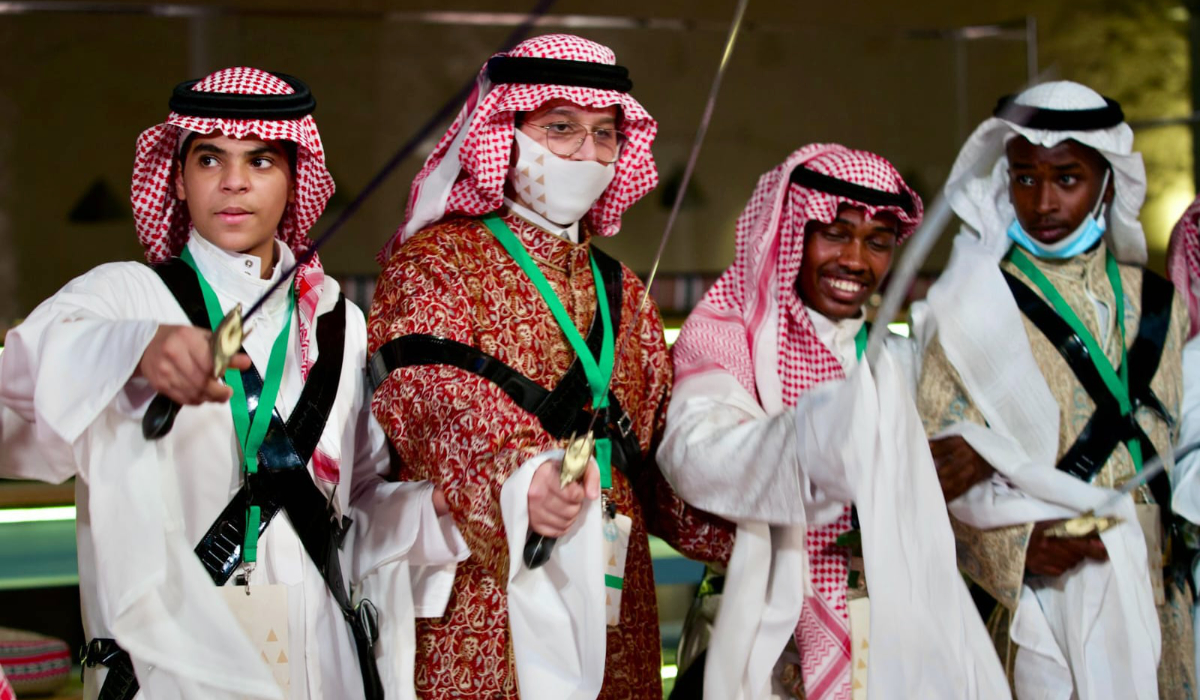
MAKKAH: Saudi Arabia is home to a rich tapestry of folkloric arts, each with its own distinct features, but all with the same purpose: to express the Kingdom’s history, culture, and heroism.
Over time, these artistic traditions have become essential components of a variety of events and holidays. They predominantly take the form of ardah — group war dances which were originally intended to terrify enemies by showcasing the performers’ military prowess and the power and courage rooted in their past.
Of the many types of ardah, the most popular style in the Kingdom is the Najdi ardah, also known as the Saudi ardah.
Saleh Nasser Al-Abdulwahed, leader of the Saudi Ardah group, told Arab News that the Najdi ardah “stands as a testament to Saudi history.”
The Najdi Ardah begins with the recital of a poem, after which the drummers begin, establishing the rhythm for the dancers to follow. The group leader then takes the stage, wielding a blade and demonstrating well-practiced movements that match those of warriors in battle. He expertly maneuvers the sword, occasionally laying it on his shoulder, lifting it high, or holding it on its side. He also uses precise finger movements to move the blade in a circular motion, demonstrating his expertise.
Usually, the dancers will be dressed in their finest military outfits.
FASTFACT
The Najdi Ardah begins with the recital of a poem, after which the drummers begin, establishing the rhythm for the dancers to follow.
“Ardah performers don Al-Murawden military uniform, featuring long sleeves. They complement it with Al-Zaboun, a finely crafted wooden cashmere fabric adorned with a cashmere shawl, meticulously made by hand, resembling the ‘dagla’ gown,” Al-Abdulwahed explained. “Additionally, the performers may opt for Al-Saya, a tailored white summer fabric, or the Jokha, which is usually reserved for dignitaries such as kings, princes, and knights.”
He noted that warriors typically choose red clothing, though the shades could vary from a bright, blood-like tone to a more muted burgundy.
The performers will also typically be heavily armed, wearing a dagger, a gun holster, a bullet holder known as mujannad, and a sword. When wearing the uniform, the participant positions his pistol holster to the left and mujannad to the right. Various types of sword are used, each with its own sheath.
The Najdi ardah is a cultural touchstone for many Saudi nationals, and remains widely practiced today, not only in the central part of the Kingdom, but all over the country. It is frequently showcased at weddings. Its involvement in such ceremonies creates a sense of joy and delight, enthralling both older and younger generations.
Folk arts in other regions
The Hejaz region is one of the Kingdom’s most diverse in terms of folk arts. It is renowned for the Majrour art form, characterized by two facing rows of performers wearing tied and belted headbands. Each individual holds a daf in hand, contributing to the performance with special tunes and melodies.
The Yanbawi tarab is a form of collective musical expression, featuring the use of a stringed instrument called a simsimiyya, which is closely tied to maritime culture.
In Taif, the ardah Al-Zir takes center stage during special occasions and holidays. This dance involves the use of swords, guns, and daggers, and is a significant element of cultural festivities.
In the northern region, the traditional arts of Al-Samari and Al-Dahha come to life with two opposing rows of performers creating harmonious rhythms, playing melodies such as Al-Mashoub, Al-Zubai, and Al-Hajini.
Credit: Source link