
In an article released today by a16zcrypto, researchers Miranda Christ and Joseph Bonneau shed light on the intricate challenges of implementing stateless blockchains. Their extensive research delves deep into the complexities of the topic, offering a fresh perspective that promises to shape forthcoming debates in blockchain technology.
In this article, we explore their research on the growth of blockchain states, the challenges of stateless blockchains, and emerging solutions.
A Deep Dive into Stateless Blockchain Technology
Blockchains have been evolving at an unprecedented pace. With the surge in user volume and transaction frequency, the amount of data or ‘state’ that validators must store to authenticate transactions also increases.
While Bitcoin’s state is limited to unspent transaction outputs (UTXOs), Ethereum’s state includes each account’s balance and the code and storage for each smart contract. But is the growing size of blockchain states sustainable, and where does the concept of “stateless blockchains” fit into the picture?
State Growth: A Looming Challenge
The research indicates that Bitcoin nodes currently store approximately 7 GB of data, and Ethereum nodes house about 650 GB. However, as the transaction throughput (TPS) grows, so does the state storage requirement.
To handle everyday transactions, which could be in the tens to hundreds of thousands of TPS, we might be looking at storage needs in the terabytes or even petabytes. The research suggests this immense storage demand could threaten decentralization by making it hard for individuals to become validators.
The idea of a stateless blockchain is appealing. According to the research, validators would only need to store a constant-sized state, regardless of the number of transactions. This could simplify the process, potentially allowing everyone to run a node on their mobile phones. In theory, this would not only make the system more decentralized but also enhance its security.
Christ and Bonneau suggest that practical implementation is still unfeasible, however. While extensive research has been done on stateless blockchains, no known model has been deployed yet. One inherent issue is the need for users to store “witnesses” that assist validators in verifying account-related transactions. These witnesses, unlike private keys, change frequently, adding undue stress on users and making the system less user-friendly.
The Impossibility of True Stateless Blockchains
Christ and Bonneau’s research has highlighted another significant challenge: the tradeoff between maintaining a concise global state and frequently updating witnesses is fundamental and unavoidable. The analysis revealed that even if a user doesn’t engage in any transactions, their witness may need to be modified based on other users’ actions.
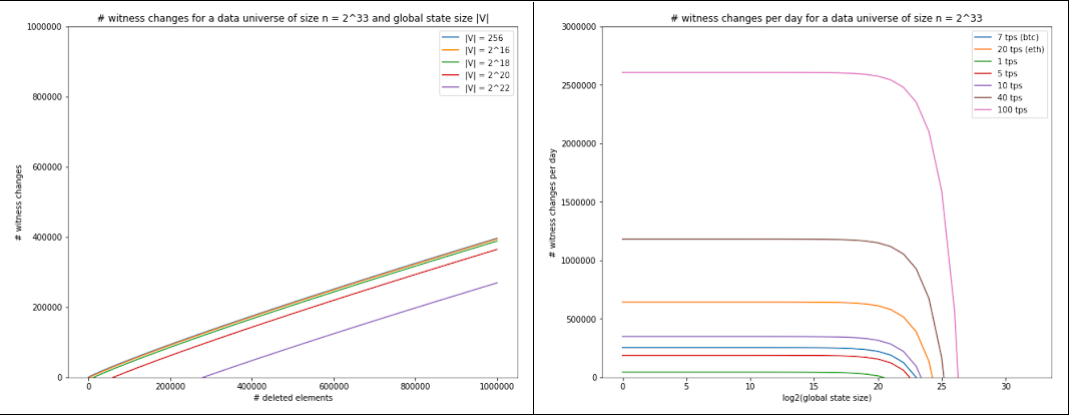
The study also employed an information-theoretic argument, using principles established by Claude Shannon, to demonstrate that a truly stateless blockchain where users never need to update their witnesses is unattainable.
The Way Forward: Exploring Alternatives
Although pure stateless blockchains may be unfeasible, the study found there are other promising solutions. One such model involves a third party, distinct from a user or validator, responsible for storing the full state.
This entity, termed a proof-serving node, would generate updated witnesses for users, allowing them to transact similarly as in a stateless blockchain. The incentives and compensation model for these nodes remain areas of active research, however.
The research findings also have implications for Layer 2 (L2) solutions like rollup servers. Despite the optimistic view that L2 rollups could be the practical implementation of stateless blockchains, the research indicates that challenges remain.
For instance, their study suggests that a user’s rollup withdrawal witness would need frequent updating, or almost the entire L2 state would have to be moved to Layer 1.
In the pursuit of enhancing efficiency, stateless blockchains have emerged as a significant area of interest. Thanks to the work of Christ and Bonneau, we have a clearer understanding of the challenges ahead.
While the dream of a pure stateless blockchain may remain just that—a dream—the research and exploration in this field are sure to set the stage for solutions that balance efficiency with user convenience.
Credit: Source link