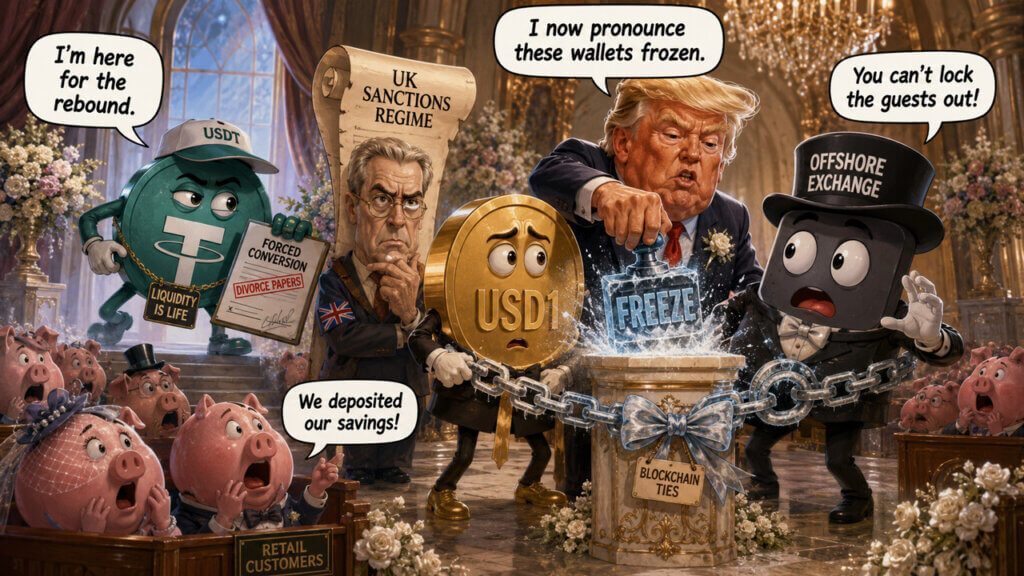
Crypto exchange HTX will permanently remove President Donald Trump-backed World Liberty Financial’s fiat-backed USD1 stablecoin from its trading platform.
Beginning June 7, the digital asset exchange said it will systematically convert all eligible retail customer balances of the USD1 token into Tether (USDT) at a strict one-to-one valuation.
This intervention arrives as direct retaliation after the Trump-affiliated decentralized finance project blocked access to several HTX-controlled blockchain addresses.
Management at the trading platform insists that the blocked wallets contain standard retail customer funds rather than illicit capital, and frames the freeze as a violation of user property rights.
The exchange added:
“Given that the USD1 stablecoin is also issued by the WLFI project team, HTX has proactively suspended trading for the WLFI/USDT, USD1/USDT, BTC/USD1, and ETH/USD1 trading pairs as of 13:00 (UTC) on June 5, 2026 to safeguard users’ assets, preserve market fairness, and mitigate potential systemic risks.”
The standoff spotlights an intensifying conflict between offshore cryptocurrency platforms and US-aligned stablecoin issuers attempting to rigorously enforce international sanctions at the protocol level.
The UK sanctions catalyst
The origins of the rift trace back to late May, when British authorities targeted digital asset infrastructure facilitating Russian financial evasion.
On May 26, the UK’s Foreign, Commonwealth, and Development Office imposed severe sanctions on Huobi Global S.A., a Panamanian corporate entity. British regulators alleged the firm helped process roughly $1.5 billion in illicit volume connected to the A7 payments network and Garantex, a heavily sanctioned Russian cryptocurrency exchange.
World Liberty Financial, which manages both the USD1 stablecoin and its companion WLFI governance token, seemingly initiated the wallet freezes to comply strictly with those newly issued British restrictions.
While the project omitted any specific mention of HTX in its public communications, it issued a broad market advisory reminding counterparties of its robust compliance protocols and its technical capability to sever ties with restricted networks.
However, HTX has forcefully rejected the premise underlying the asset freeze.
The exchange’s representatives argue that the contemporary digital asset platform operates entirely independently from Huobi Global S.A., the specific legacy entity named in the UK government’s sweeping May designations.
In aggressive public statements, HTX officials characterized the World Liberty team’s actions as a massive overreach that bypassed basic legal frameworks, transparent disclosure, and standard industry communication.
Molly Fu, a spokesperson for the exchange, clarified that the locked capital belongs exclusively to ordinary retail buyers and possesses no connection to sanctioned actors.
The platform has continued to demand an immediate reversal of the blockchain-level restrictions, warning that treating customer holdings as collateral damage sets a dangerous precedent for the broader digital economy.
WLFI has a precedence of locking tokens
World Liberty Financial’s willingness to lock wallets via smart contract functions is not unprecedented, though deploying the mechanism against an institutional exchange marks a significant escalation in its compliance strategy.
The project, launched in late 2024 by members of the Trump family, uses an architecture that allows administrators to unilaterally halt token transfers.
The most prominent prior application of this sweeping authority involved Justin Sun, the billionaire founder of the Tron blockchain network and a global advisor to HTX.
Notably, the legal hostilities between the Trump-backed enterprise and Sun predated the current exchange-level crisis.
The conflict initially came to public view when World Liberty filed a high-profile lawsuit against Sun in Florida state court. The litigation alleged that the entrepreneur violated early investor agreements, engaged in unauthorized short sales to depress the token’s market price, and executed prohibited straw purchases.
According to the company’s legal filings, the initial September 2025 freezes on Sun’s personal holdings were necessary measures to defend the token ecosystem from market manipulation.
However, Sun rejected those allegations and claimed that he was unfairly stripped of his governance voting rights. He also argued that punishing dissenting token holders violated the fundamental tenets of decentralized finance.
Nonetheless, the current predicament involving HTX operates on a distinctly separate track from Sun’s personal legal battles.
While Sun’s dispute centered on individual governance conflicts and alleged market manipulation, the HTX freeze directly impacts wholesale exchange liquidity and retail depositors.
The tension between compliance and decentralization
The standoff crystallizes a fundamental vulnerability within modern stablecoin architecture and the broader tokenized asset sector.
While leading fiat-backed tokens like USDC and Tether routinely freeze individual wallets directly linked to criminal enterprises, terrorism financiers, or North Korean hacking syndicates, executing a blanket freeze on exchange-aggregated wallets introduces severe collateral consequences for everyday market participants.
The USD1 token has expanded aggressively since its introduction, with its circulating supply reaching more than $4.6 billion.
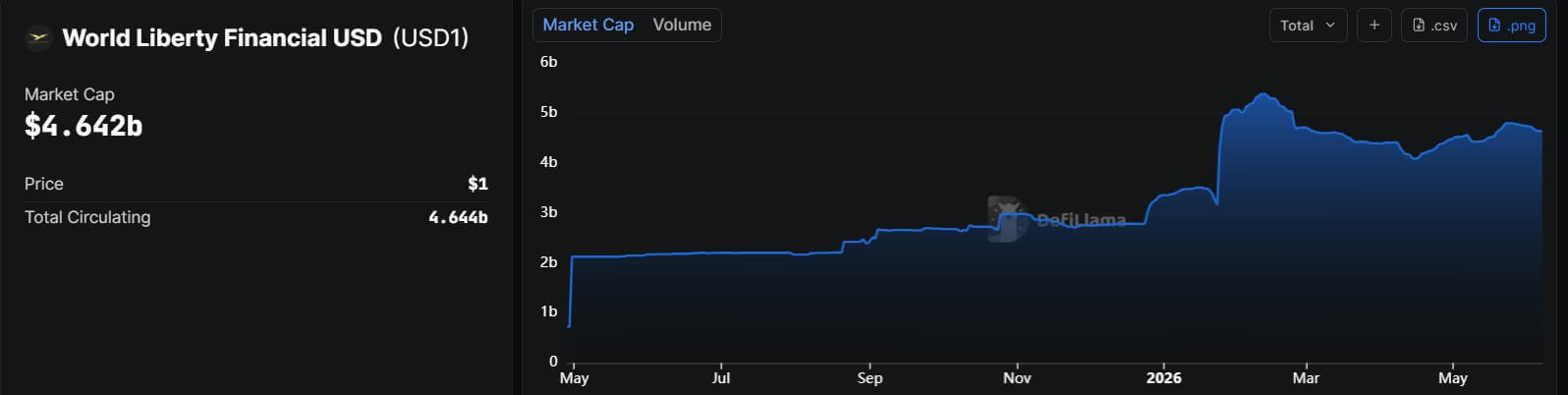
The asset has been heavily pitched to institutional players seeking a regulated, heavily audited alternative to legacy stablecoins, buoyed significantly by the high-profile political connections of its primary sponsors.
Yet, HTX’s forced delisting reflects the inherent friction between institutional-grade compliance and permissionless global market access.
By neutralizing USD1 trading on a major international venue, the dispute demonstrates how localized regulatory designations, such as the UK’s targeting of Russian evasion networks, can instantly ripple through the broader digital asset economy, forcing immediate liquidity crises.
Exchange management indicated that all relevant asset pairs will remain offline indefinitely as they continue attempting to negotiate a release of the frozen balances.
Until World Liberty Financial either unwinds the restrictions or provides a transparent accounting of its internal compliance review process, HTX customers will find their previously held USD1 entirely converted into Tether.
Market participants and legal experts now await formal clarification from the World Liberty team regarding the exact evidentiary threshold required to trigger protocol-level account suspensions.
Credit: Source link