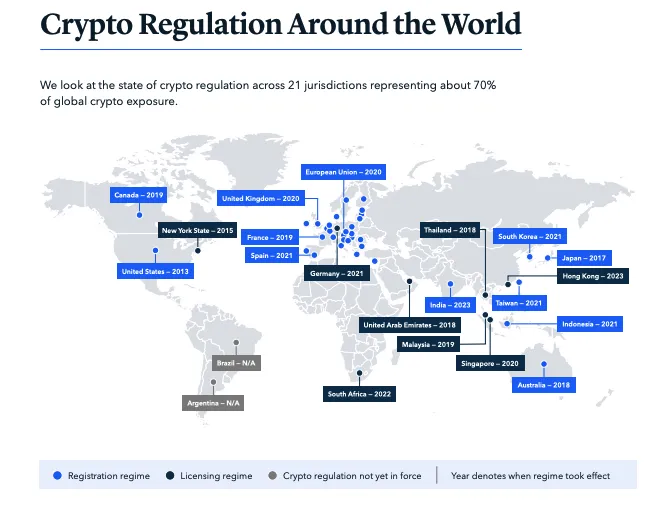
The European Parliament and the European Council have agreed to set up a new Anti-Money Laundering Authority in Frankfurt. The decision came following a 2023 EU decision to supervise crypto firms and financial services providers that operate internationally.
European Union (EU) authorities agree to institute an anti-money laundering watchdog in 2025 amid heightened scrutiny of the role of crypto firms in terrorist financing.
Why the European Money Laundering Focus?
The EU says its new anti-money laundering watchdog will have 400 staff when it launches in Germany next year. Nine countries, including France, Italy, Spain, Latvia, and Ireland, applied to host the agency.
The AMLA will require credit and financial institutions and crypto asset service providers to conduct customer due diligence. A crypto exchange must conduct due diligence to verify customer information and report suspicious activity to the EU’s Financial Intelligence Units. Last year, EU supervisory board member Elizabeth McCaul said it was important to consider an exchange’s global operations to assess its financial health since regulators looking only at local operations cannot accurately judge a firm’s risk.
A case in point was Binance, which French authorities investigated for money laundering. The US later charged the exchange for letting terrorists use its platform. However, a 2023 journal article in Oxford Academic said that while cryptocurrency can be attractive to terrorists, groups cannot often convert it to main currencies.
Read more: Crypto Regulation: What Are the Benefits and Drawbacks?
“In contrast, cryptocurrency is not attractive to terrorist financing because of the large fluctuation of cryptocurrency prices, the lack of trust mechanisms, the difficulty of conversion to main currencies, and the maturity of global fund tracking technology,” said Shaceng Wang and Xixi Zhu.
AMLA Dampens MiCA Enthusiasm
The EU’s announcement was met with backlash from the crypto community, some of whom accused the EU of money laundering itself. WalkerAmerica, a Bitcoin podcast host, rhetorically asked whether AMLA rules applied to banks.
“So you’re going to crack down on the big banks who do all the money laundering?” Walker wrote.
The AMLA decision comes after the European Union finalized its Markets-in-Crypto-Assets bill to regulate cryptocurrencies in April 2023. The bill, which will come into effect for exchanges later this year, addresses new token issuances, anti-money laundering regulations for exchanges, and stablecoin rules. A stablecoin is a tokenized version of fiat currency that crypto market participants can easily exchange for cryptocurrencies.
Read more: What Is Fiat Currency? How Does It Differ From Cryptocurrency?
French banking giant Societe Generale recently launched a euro-denominated stablecoin. USDC issuer Circle has recently expanded its euro-based stablecoin to the Solana blockchain.
These plans suggest that institutions expect demand to move funds between crypto and tokenized euro assets soon. For a while now, citizens have been skeptical about the EU’s plans to launch a central bank digital currency (CBDC). BeInCrypto contacted the press department of the European Parliament for comment but had yet to hear back by press time.
Disclaimer
In adherence to the Trust Project guidelines, BeInCrypto is committed to unbiased, transparent reporting. This news article aims to provide accurate, timely information. However, readers are advised to verify facts independently and consult with a professional before making any decisions based on this content. Please note that our Terms and Conditions, Privacy Policy, and Disclaimers have been updated.
Credit: Source link